Showing posts with label Birds. Show all posts

Saturday, 28 April 2012

Ivinghoe Beacon

A couple of weeks ago I had an uncharacteristic rush of blood to the head and leapt out of bed at 5.00am on Saturday morning and headed excitedly to Ivinghoe Beacon, my plan to try and find the Redstarts that had been seen on the hills late the evening before. As I drove up the winding road to the Beacon car park I noticed that the temperature gauge in the car was reading only 3 degree and my enthusiasm rapidly started to wane. The hills were swathed in low cloud and murk and looked decided unappealing, and as I stepped out of the car my worst fears were realized. It was bitterly cold and the stiff north-east wind soon told me in no uncertain terms that I was badly under-dressed. There was little chance of a Redstart emerging from the bushes in such miserable weather, so I trudged up to the top of the Beacon to try and find a Ring Ouzel, without doubt one of my favourite birds. There had been up to 13 Ouzels on the rabbit scarred southerly slope of the Beacon over the previous week, and I had been lucky enough to witness 10 of these enigmatic birds rise up from the hill and gather into a noisy flock over my head - an unforgettable moment. I managed to locate 3 birds in the gloom before heading back to the car, the icy wind still nagging at my back, my fingers numb and consumed by the feeling that I should have stayed in bed. Ironically, later that morning, on the way home, I saw a beautiful male Redstart flitting along a hedgerow in the cold morning sun, near Drayton Beauchamp village, only a mile or so from my house.

The view from Ivinghoe Beacon, early morning, (14/04/2012)

Grasshopper Warbler

For a couple of weeks this Grasshopper Warbler Locustella naevia showed well from Willows next to the Grand Union towpath at Marsworth Reservoir. In typical fashion the bird spent much of the time reeling from deep in tangled bushes or from low in the reeds, but occasionally it would perch half way up a small Salix and let rip. Despite the tree being so close to the busy towpath the bird seemed completely unconcerned by the noisy passers by and would often reel in the open for several minutes before flitting down into cover. Grasshopper Warblers are not easy to photograph at the best of times but this showy little bird gave all the local photographers a fighting chance to get some good shots, many of which far outshone my efforts. As time passed the bird became more and more elusive but it may still be around, although there have been no reports recently.

Grasshopper Warbler Locustella naevia - Marsworth Reservoir (14/04/2012)

Grasshopper Warbler Locustella naevia - Marsworth Reservoir (14/04/2012)

Saturday, 31 March 2012

Mandarin Duck

A pair of Mandarin Ducks have been hanging around the small pond close to Monument Drive in Ashridge Forest, near Aldbury Village. Though not exactly tame the pair are fairly tolerant of the hoards of dog walkers, joggers and screaming children that invade the forest every day, and hopefully will breed nearby, despite the noise and disturbance. Mandarins breed in cavities in trees in dense woodland near ponds and streams and soon after the ducklings have hatched the mother flies down to the ground and encourages the young to leap from the nest. When all the ducklings are safely out of the tree they follow their mother to a nearby water body. Incredibly the nest can be as much as a mile from the nearest water. Mandarin Ducks in Britain are all the descendants of escaped or deliberately released birds and the population is now in excess of 7000, exceeding the number of birds in China and Eastern Russia which has declined to only 1000 pairs, mainly due to habitat destruction. Strangely, the Mandarin is of the few duck species that is not hunted for food as apparently the meat tastes terrible.

Mandarin Duck Aix galericulata, male - Ashridge Forest

Mandarin Duck Aix galericulata, male & female - Ashridge Forest

Mandarin Duck Aix galericulata, female - Ashridge Forest

Mandarin Duck Aix galericulata, male - Ashridge Forest

Mandarin Duck Aix galericulata, male - Ashridge Forest

Monday, 30 January 2012

Postcard From The Himalayas

The Himalayas above Dharamasala, Himachal Pradesh, India (09/01/2012)

I have just returned from a rather fraught few weeks, travelling and birding in Northwest India. Unfortunately I was plagued by heavy snow in the Himalayas, which curtailed many of my plans as roads soon became impassable or were closed down. Despite the problems the snow caused it did make for some spectacular scenery and drove many birds down from the mountains into the lower valleys, making the birding very interesting. Once out of the mountains I thought I would be leaving the poor weather behind me, but I was in for a shock as heavy morning fogs and rain set about ruining my plans and making birding very difficult. Add to that a couple of bus breakdowns, train journeys which ended up arriving hours late and to cap it all being bitten by a stray dog and I was beginning to get the feeling that I was cursed! I had so much bad luck that I half expected the plane to crash on the way home so it was quite a relief to touch down at Heathrow in one piece!
On my first morning back, head still blurry from jet lag and lack of sleep, but feeling the need for some fresh air, we wandered over to College lake to try and see the Little Auk Alle alle that had been found there the previous afternoon. This was a really bizarre record and I was quite keen to see the bird as soon as possible as I knew that Alcids have a habit of going belly up when they turn up in land. Sadly we arrived too late. The poor little thing had pulled itself up onto the shore and had been promptly pecked to death by two Carrion Crows. A rescue bid had been made but to no avail, and all I got to see was the tiny dead bird in the hand. Quite sad really. To cheer myself up we stopped of at Startops Reservoir to try and find the long staying Snow Bunting that had been in residence since December. We soon found it feeding unobtrusively on the same stretch of stony shoreline that I had last seen the bird a month before. For second it felt as if I had not been away at all.

Sunday, 27 November 2011

There'll be Bluebirds over...

A few days ago I found a copy of Local Life, a free magazine of 'news and views', nestling on top of the day's consignment of junkmail that had been violently forced through my letterbox. Packed with gardening tips, church news and adverts for mobile hairdressers, school fetes (a fete worse than death) and Dog-walking services, the arrival of this exciting magazine is always highly anticipated in our household! As I trod the well worn path to the recycling bin I glanced at the front cover and it stopped me in my tracks. An attractive seasonal scene featured couple of Bluebirds at a bird table feasting on Mealworms, a photograph obviously taken in America. A quick glance at Sibley's Birds of North America confirmed, as I had suspected, that they were female Eastern Bluebirds. Obviously the twit who had chosen the photo had seen the reddish breasts and had thought that they were Robins! Unless of course there are a couple of Bluebirds lurking in a garden in the Tring area! Now that really would be something.....

Monday, 31 October 2011

Murderous Mute Swans

On Saturday morning with a cold North-westerly wind blowing in my face, I whiled away an hour or so on the jetty at Wilstone Reservoir, swapping news with Steve, a birding friend from Tring. We were watching a Water Pipit threading a path through a gaggle of sleeping Shovellers, as it worked it's way busily along the water's edge, when something rather strange caught my eye. For a few seconds I couldn't work out what was happening. A Mute Swan had clambered onto the back off another Swan and was pecking violently at it's neck and head as the half submerged victim swam slowly towards the spit in a desperate bid to escape. This proved to be a bad move as the stricken bird soon became beached in the shallow water and unable to break free, lay prostrate, neck outstretched as it's assailant rained down blows and attempted to hold it's head under water. Several other curious Swans soon gathered at the scene of the crime and I feared that they were going to join in the attempted murder, but instead they became very territorial and set about squabbling with each other. Steve told me that he had witnessed Mute Swans trying to drown each other before and had once seen a man in a rowing boat repeatedly beating a Swan with an oar in a bid to persuade it to release it's victim. We had begun to talk about the possibility of making a strategic rescue bid when the aggressor suddenly seemed to lose interest and stepped off it's bedraggled victim, who waddled unsteadily onto the spit, only to be chased away by another Swan. Many people believe that nature should be allowed to take it's course but I am a confirmed intervener, so I was relieved when the situation resolved itself without our help.

Thursday, 27 October 2011

Eurasian Coot

I took these photos of an oddly marked Coot at Wilstone Reservoir way back in October 2009, so was quite surprised to see the same bird again a few days ago. Coot numbers are building up at the reservoirs, probably encouraged by the low water levels, with at least 1500 at Wilstone recently.

Eurasian Coot Fulica atra - Wilstone Reservoir (18/10/09)

Eurasian Coot Fulica atra - Wilstone Reservoir (18/10/09)

Sunday, 20 March 2011

The First Swallow

On Friday it was my birthday and I had the unexpected present of my first Barn Swallow Hirundo rustica of the year. I had the day off and decided to drop in at Wilstone Reservoir despite the pouring rain, in the hope of seeing a Scandinavian Rock Pipit Anthus petrosus littoralis that had been found earlier that morning. Two Chiffchaffs were cheerfully singing, a few Sand Martins were sallying high over the water and then all of a sudden there it was, a lone Swallow, hugging the surface, feeding busily. This was the earliest Swallow I can remember seeing by several days and a heartening sight, bringing with it the faint promise of summer. Frustratingly, the Rock Pipit was constantly flushed by a group of noisy ramblers and proved hard to see, so I visited the reservoir again in the evening and was lucky to have some excellent views as it fed quietly in the evening sun amongst the rocks by the jetty. The Swallow had already moved on, it's visit brief but welcome.


Barn Swallows in Autumn, (21/08/2010)

Saturday, 19 February 2011

Red-crested Pochard

A couple of weeks ago while I was wandering past Marsworth Reservoir I noticed a pair of Red-crested Pochard Netta Ruffia. The male was swimming alongside the female and energetically displaying by stretching it's head back and flicking it's bill upwards. These attractive ducks prefer to nest in lakeside vegetation, so Marsworth, which is fringed by extensive Reedbeds is ideal. Unfortunately the water is full of predatory fish and the area is also plagued by Mink, so keeping a family of downy young safe is virtually impossible.
Here are some photos taken last May and then again a month later showing the last remaining duckling from the original brood of nine.
Let's hope that they have better success this year!

Female Red-crested Pochard and duckling (Marsworth Reservoir, 14/05/2010)

Add Video
Red-crested Pochard duckling (Marsworth Reservoir, 14/05/2010)

Female Red-crested Pochard and juvenile (Marsworth Reservoir, 09/06/2010)

Juvenile Red-crested Pochard (Marsworth Reservoir, 09/06/2010)

Juvenile Red-crested Pochard (Marsworth Reservoir, 09/06/2010)

Sunday, 12 December 2010

Robin

"Art thou the Bird whom Man loves best,
The pious Bird with the scarlet breast,
Our little English Robin;
The Bird that comes about our doors
When Autumn winds are sobbing?"
From 'The Redbreast and the Butterfly' by William Wordsworth

(European) Robin Erithacus rubecula (20/12/2009)

No apologies for the shameless sentimentality of this seasonal picture! I came across this particularly friendly Robin taken near Tringford Reservoir and it got me me thinking about why the Robin Erithacus rubecula has become a symbol of Christmas and traditionally appears on cards and decorations. The first card depicting a Robin appeared in the 1860's, the bird pictured delivering an envelope and Postmen at the time wore red tunics and were nicknamed 'Robin Redbreasts'. I assumed that there would be an interesting folk tale or myth that explained this close association with the Christmas season, but the truth is much simpler. With food scarcer, Robins are at their most tame and visible in the winter and their bright red breast, often puffed up to help retain warmth brings colour to dull wintry surroundings. Male Robins often sing in the winter to establish territory and their sweet song undoubtedly would have filled people with the promise of Spring and better weather to come to. Perhaps, as the familiar birds of summer slowly melted away people felt they could rely on the Robin to stay with them and brave the winter, to keep them company and cheer them up through the long dark days. So the Robin has long been a part of the festive season and when cards became popular in Victorian times they soon became a popular subject and in 1960 officially became Britain's national bird. Of course, what people didn't realise is that the Robin in their garden may well have come from Northern Europe to spend the winter here!There is however a wealth of Folklore surrounding the Robin with perhaps the strangest tale being that if one finds a dead body it will cover it with leaves and moss. In the ancient tale of the Babes in the Wood a Robin carefully covers the dead bodies of the two lost children with leaves. It seems a bizarre idea but perhaps it stems from observations of Robins throwing leaves around as they search for food on the forest floor.

"Can this be the Bird, to man so good,
Our consecrated Robin!
That, after their bewildering,
Did cover with leaves the little children,
So painfully in the wood?"
From 'The Redbreast and the Butterfly' by William Wordsworth

An old superstition says that it is very bad luck to kill a Robin and according to one story if you do your hands will never stop shaking. At least this has meant that the Robin has always been revered and treated well by man. As a gardener I am well used to Robins pottering around my feet, perching on Spades and Wheel Barrows and very occasionally taking a worm from my hand, but this is a sign of how well we have treated these iconic birds for centuries. Sadly this is not the case in some parts of Southern Europe where Robins along with many other small birds are still trapped and eaten in huge numbers. This persecution has meant Robins are very shy and wary and often hard to see. A few years ago we spent a cheap and cheerful week in Tenerife and it took me until the end of the holiday before I eventually found a Robin (since split as Tenerife Robin), skulking deep in the undergrowth of a montane pine forest.

There are several tales explaining the origin of the red breast which centre around acts of kindness by the "pious" and "consecrated" Robin. Its was believed that a Robin pulled a thorn from the crown that had pierced the head of Jesus Christ as he made his way to the cross and was splattered with blood. In another story the birds breast was burnt while carrying water to sinners in hell. It is ironic that such an aggressive and occasionally murderous bird has gained such a kind and holy reputation!

Bohemian Waxwing


More Waxwings! But who could resist a flock of 40 of these gorgeous birds on a bright and beautiful sunny morning only a few miles from home. Typically, these birds had chosen to settle in the picturesque surroundings of the Tesco car park in Leyton Buzzard and to be honest, as I arrived I had an attack of cold feet and was almost tempted to turn round and drive home. There's something slightly cringe-making about bird watching in these sort of places, being stared at by shoppers who obviously think you are a bit of a twit and can't understand why you would possibly want to spend your Sunday morning watching birds when you could be Christmas shopping! Maybe it's just me, but I find the whole thing a bit embarrassing and it doesn't help being surrounded by photographers clad from head to toe in camouflaged clothing, which as we all know is vital for blending into the concrete habitat of a supermarket car park! Perhaps I will have to grow a thicker skin! Nevertheless the stunning birds soon took my mind off the hideous surroundings and I managed to grab these photos as the birds fed busily on the blood red berries of a group small Rowan trees, before suddenly flying off purposefully southwards.


Bohemian Waxwing Bombycilla garrulus (Leyton Buzzard, 12/12/2010)

Thursday, 2 December 2010

Bohemian Waxwing

At last! I spent the last days of November in an increasingly agitated state wondering if I was ever going to catch up with some Waxwings this year. With the severe weather in the north driving them southwards it seemed inevitable that a few of these wonderful birds would turn up in the Tring area. Unfortunately it was equally inevitable that when they did I would manage to miss them! A small group of 8 were found last Saturday and were briefly relocated again the next morning, but I was too late on the scene on both occasions. I spent a fruitless hour or so on Sunday morning scouring the residential streets of Tring carefully checking all the Rowan trees and other promising berry laden shrubs, but sadly they were not seen again.
Luckily some Waxwings chose to settle at Woburn in the same street lined with ornamental white Rowan trees that had been graced by a small flock earlier in the year. The snowfall in the night had made garden work almost impossible, so I gave myself the day off and took the opportunity to drive over to see them. Apparently there had been over 100 birds in the town earlier in the day which would have been quite a sight, but when I arrived at midday the numbers had fallen to small skittish flock of 24. Having gorged themselves on berries all morning the birds spent long periods perched high in the bare branches of a distant tree silhouetted against an ice blue winter sky, only occasionally dashing down to the Rowans for a few seconds to grab some berries in a half hearted way. It was almost as if they felt they ought to be feed as it was so cold, but actually couldn't be bothered because they were so full! The result was that I struggled to get any decent shots of the birds feeding and after a couple of hours the creeping numbness of my fingers and toes signalled to me that it was time to head home to the warmth and a cup of tea.

Bohemian Waxwing Bombycilla garrulus (Woburn, 30/11/2010)

Bohemian Waxwing Bombycilla garrulus (Woburn, 30/11/2010)

Thursday, 18 November 2010

Bohemian Waxwing

I'm still waiting excitedly for my first Waxwing of the year. It's a big invasion year but so far the vast majority of birds are still lingering in the northern half of the country and although there have been a few brief sightings reported locally as yet no birds have chosen to stick around. Driving through the country lanes I've been scanning the berry laden hedgerows and as I work I have been listening out for that beautiful shivering trill, but so far without success. These lovely birds always stir the imagination with romantic images of the vast Northern Coniferous forests, so it seems ironic that we usually end up seeing them in the grim surroundings of a business estate or supermarket car-park. These photos were taken in February 2009 in the slightly more upmarket environs of Woburn town centre, but sadly they do not really do these stunning birds justice. Waxwings seem to soak up the cold winter sun and positively glow, but sadly the Sorbus (Rowan) that these birds favoured remained in shadow despite it being a clear bright day. Fingers crossed for some better shots this winter!


Bohemian Waxwing Bombycilla garrulus, Woburn (21/02/2009)

Tuesday, 31 August 2010

Whooper Swan

If you come across a couple of Whooper Swans Cygnus cygnus at the Tring Reservoirs complex don't get too excited, as chances are they are the feral pair that have visited the area periodically for the last three years. I am not sure of the exact provenance of these two birds, but they may have originated from a private collection in Bedfordshire. The photos below were taken on a dull, grey day in September 2008, but I saw what are probably the same birds a few days ago at Wilstone Reservoir. The pair were engaged in a raucous greeting or bonding display with entailed a lot of neck bending and stretching accompanied by loud honking and trumpeting. Wherever they come from it's good to have these elegant swans around for a few days and to hear their evocative calls echoing across the water, like the first breath of Winter.

Whooper Swan Cygnus cygnus. Wilstone Reservoir 06/09/2008

Whooper Swan Cygnus cygnus. Wilstone Reservoir 06/09/2008

Whooper Swan Cygnus cygnus. Wilstone Reservoir 06/09/2008

Monday, 23 August 2010

Collared Dove

Last Saturday after spending the day at the Birdfair at Rutland Water, I arrived home after the two hour drive, feeling tired and light of wallet to be confronted with an obviously sick and distressed Collared Dove Streptopelia decaocto on the lawn of my back garden. I picked up the forlorn bird to examine it and my heart sank when I saw that the right eye was red, swollen and closed over and what appeared to be part of the brain, was protruding grotesquely from the side of the head. My first thought was that the unfortunate bird had been struck by a Sparrowhawk or possibly a cat. Resigning myself to a 40 minute round trip to St Tiggywinkles Wildlife Hospital near Thame I put the dove in a cardboard box, jumped back into the car and raced off. Arriving at the hospital I joined the queue behind a juvenile Common Tern and a baby Edible Dormouse and waited my turn. As soon as the Dormouse was dealt with the Nurse had a look at my casualty and immediately exclaimed, "oh it's only a tick!", much to my relief and mild embarrassment considering my rather dramatic diagnosis! What I had assumed was part of the dove's brain was in fact a blood bloated tick and the horrible state of the eye was the result of an infection caused by the bite. I was told that the tick would be removed and the dove given a course of antibiotics, and stood a very good chance of making a full recovery. Apparently Collared Doves are prone to tick bites and are often brought in to the hospital for treatment. I drove home pleased that this story would hopefully have a happy ending.

If anyone finds a sick of injured Bird or Mammal the address of St Tiggywinkles Wildlife Hospital is:
Tiggywinkles, Aston Road, Haddenham, Bucks, HP17 8AF
Tel: 01844 292292
Email: mail@sttiggywinkles.org.uk

Wednesday, 18 August 2010

Black-necked Grebe

I spent an enjoyable hour in the hide at Wilstone Reservoir on Tuesday watching this juvenile Black-necked Grebe Podiceps nigricollis which showed really well in the late afternoon sunshine. It was actively feeding in between bouts of sleeping and eventually swam close enough to the hide for me to grab this photo. The upended Mallard in the background gives a good idea of the tiny size of Black-necked Grebe, only slightly larger than a Little Grebe.

Juvenile Black-necked Grebe Podiceps nigricollis - 17th August 2010

The supporting cast included this Common Kingfisher Alcedo atthis which perched for some time on a branch close to the hide. Kingfishers must have had a terrible time in the hard winter so its great to see a pair regularly at Wilstone at the moment. Frustratingly the bird was in the shade, just out of the sunshine that would have brought it's stunning colours to life.

Common Kingfisher Alcedo atthis

Common Kingfisher Alcedo atthis

Common Kingfisher Alcedo atthis

Working their way busily through the shallows were the 2 juvenile Black-tailed Godwits of the ssp. islandica that have been present at the reservoirs for a few days. These Icelandic birds have shorter bills and legs, and darker summer plumage than ssp. limosa from the rest of Europe. Also present was the rather drab eclipse drake Garganey that has been around for a while and, just as I was leaving, a Greenshank which must have flown in unnoticed popped up on the mud to the left of the hide.

Monday, 16 August 2010

Red-crested Pochard

This pair of Red-crested Pochards Nettia ruffia stayed at Startops and Marsworth Reservoirs for a few weeks from March 19th to April 9th 2008 and the female was briefly seen later in June with one small duckling which did not survive. Like many Red-crested Pochards in this country these birds were fairly tame and approachable making them easy to photograph. This year a pair bred sucessfully at the reservoirs with one young bird surviving from the original brood of nine with the rest probably falling victim to predatory Pike or Mink. Sadly this is the fate that befalls many of the duckings and young Moorhens on the reservoirs.

Red-crested Pochard Nettia ruffia, male and female

Male Red-crested Pochard Nettia ruffia

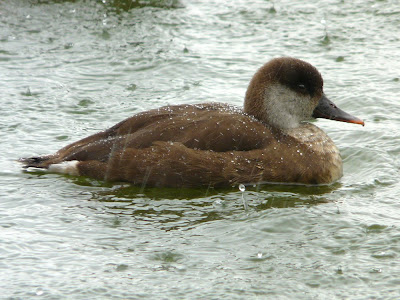
Female Red-crested Pochard Nettia ruffia


Female Red-crested Pochard Nettia ruffia