Showing posts with label Plants. Show all posts

Monday, 24 September 2012

Fly Orchid f. luteomarginata

This Fly Orchid Ophrys insectifera, photographed at a local site in June, displays some characteristics of the rare form luteomarginata. This highly distinctive form, once thought to be a separate species, is characterised by a yellow margin that fades to brown with age. This interesting plant was weakly marked but looked very different from the Fly Orchids that were growing in profusion at the near-by and is far from being a typical example of luteomarginata.

Ophrys insectifera f. luteomarginata - Buckinghamshire, 16/06/2012

Ophrys insectifera f. luteomarginata - Buckinghamshire, 16/06/2012


 Ophrys insectifera f. luteomarginata - Buckinghamshire, 16/06/2012


Compare the flower above with the typical Fly Orchid Ophrys insectifera shown below, photographed at the same site a few days earlier..


Ophrys insectifera, Buckinghamshire, 04/06/2012

Thursday, 21 June 2012

Cornfield Flowers


The Arable Weed project at College Lake Nature Reserve looks wonderful at the moment - a sea of Corn Chamomile Anthemis arvensis, dotted with bright red Corn Poppies Papaver rhoeas and livid blue Cornflowers Centaurea cyanus. A closer look reveals rare or virtually extinct arable plants such as Corncockle, Pheasant's eye and Field Cow-wheat. Sadly this is a sight lost forever from the British countryside.

Corn Chamomile, Corn Poppy and Corn Marigold - College Lake, Buckinghamshire (17/06/2012) 

Corn Chamomile, Corn Poppy and Corn Marigold - College Lake, Buckinghamshire (17/06/2012)        

Monday, 18 June 2012

Fly Orchid

One compensation for the dreadful spring and early summer have been the Orchids, which have been thriving in the wet conditions. In early June I paid a visit to a small local Nature Reserve to check on the Fly Orchids Ophrys insectifera and was amazed at the number I found. A quick search turned up 30 plants and I have since found out that the official count for whole Reserve is many times that figure.
Fly Orchids are rare in the UK and are mainly found in the Southern half of the country. Despite it's name the flower mimics the female Digger Wasp, even producing a Pheromone to entice a male wasp into acting as an unwitting pollinator as it attempts to mate with it. There can be as many as 20 flowers on each spike which can grow as tall as 60 cm, but the plants can be very inconspicuous and hard to find. Although tolerant of a broad range of habitats, Fly Orchids prefer calcareous soils and can be found in Beech woods, grassy places in shade and even fens.


Fly Orchid Ophrys insectifera (04/06/2012)

Fly Orchid Ophrys insectifera (04/06/2012)

Fly Orchid Ophrys insectifera (04/06/2012)

Fly Orchid Ophrys insectifera (04/06/2012)

Fly Orchid Ophrys insectifera (04/06/2012)


Fly Orchid Ophrys insectifera (04/06/2012)

Sunday, 20 May 2012

Few-flowered Garlic

Few-flowered Garlic Allium paradoxum

A mass of Few-flowered Garlic Allium paradoxum carpets the shadier, dryer parts of Drayton Beauchamp Churchyard and the adjacent canal bank. Identifying the plant was not a problem as the colony at Drayton Beauchamp is actually mentioned in Fitter and Fitter's Wild Flowers of Great Britain and Ireland.
Native to the Caucasus and Iran, Few-flowered Garlic was first recorded in Edinburgh in 1863 and is now naturalised and abundant in Southern Scotland and the East of England. Flowering from April to June, it is a highly invasive plant that spreads rapidly by means of bulbils which are small bulbs produced at the top of the stem.
I picked a few leaves to try out in a salad and they were delicious, although I found out later that they are slightly poisonous, especially to dogs. I didn't notice any ill effects though! 

Few-flowered Garlic Allium paradoxum, Drayton Beauchamp. (22/04/2012)

Few-flowered Garlic Allium paradoxum, Drayton Beauchamp. (22/04/2012)

Few-flowered Garlic Allium paradoxum, Drayton Beauchamp. (22/04/2012)

Sunday, 29 April 2012

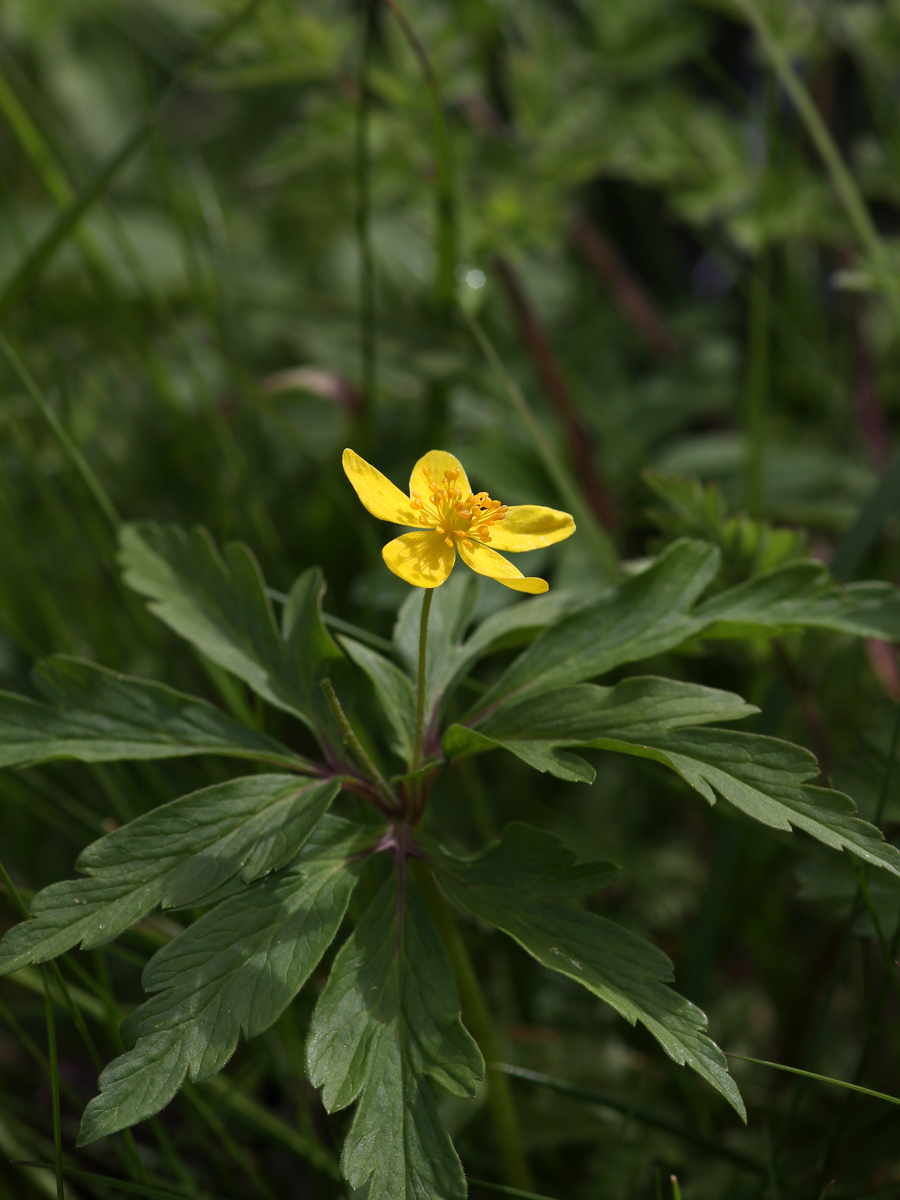
Yellow Wood Anemone

Yellow Wood Anemone Anemone ranunculoides, Drayton Beauchamp Churchyard (21/04/2012)

A little colony of Yellow Wood Anemone grows in a quiet neglected corner of Drayton Beauchamp Churchyard, close to Wilstone Reservoir. This delicate little plant, also known as Buttercup Anemone is related to Anemome nemorosa, the familiar Wood Anemone or Windflower that decorates sunny roadside banks in early spring. Yellow Anemones are widely cultivated in gardens especially by rock garden enthusiasts and are frequently escapes, often naturalising in shady places and rough ground.

Yellow Wood Anemone Anemone ranunculoides, Drayton Beauchamp Churchyard (21/04/2012)

Yellow Wood Anemone Anemone ranunculoides, Drayton Beauchamp Churchyard (21/04/2012)

Saturday, 31 March 2012

Coltsfoot

March is the month when Coltsfoot Tussilago farfara explodes into beautiful, bright yellow colonies along roadsides and on waste and disturbed ground. Easily mistaken for Dandelions, they in fact flower earlier and are one of the few plants that benefit from the relentless mowing and strimming of roadsides by local councils. The flowers appear on leafless, scaly stalks with the leaves do not appearing until the seeds are set, usually in May. The plant gets it's name from it's leaves which superficially resemble a Colt's foot in cross section, although other common names include Horse's Foot and Bull's Foot. Coltsfoot is native to Europe and parts of Asia and is also found in North and South America where it has been introduced.


Coltsfoot Tussilago farfara (Roadside near Wilstone Reservoir)

Sunday, 28 August 2011

Cornfield Flowers

Common Poppies Papaver rhoeas and Cornflowers Centaurea cyanus (14/06/2008)


These plants were all photographed at the College Lake Cornfield project, which is an attempt to conserve several rare and plants, such as Corncockle and Pheasants Eye, both sadly extinct in the wild in Britain. The small cornfield, which is cultivated traditionally using vintage farm equipment, is at it's most colourful in June and July, and it is a sobering thought that not so long ago our arable fields were full of these beautiful plants. Tragically, intensive agriculture and the relentless drive for cheaper food means that sights like this have been lost forever from our countryside.

Common Corncockle Agrostemma githago (26/06/2008)


Pheasant's Eye Adonis annua (06/06/2010)


Cornflower Centaurea cyanus (20/06/2008)


Crested Cow-wheat Melampyrum cristatum (06/06/2010)

Thursday, 25 August 2011

Yellow Bird's-nest

Yellow Bird's-nest Monotropa hypopitys, also known as Dutchman's Pipe or Pinesap, is a strange herbaceous plant completely devoid of functional leaves and unlike most plants, containing no chlorophyll. It is a saprophyte, obtaining it's food from decaying organic material in the soil by forming a mycorrhiza (symbiotic relationship) with fungi that have formed a mycorrhiza with nearby trees. In this way the Yellow Bird's-nest is able to feed without the need for photosynthesis. The tiny fleshy plants are between 10cm to 35cm, flowering in woodland from early summer to mid autumn, the small bell-like flowers drooping before becoming erect as the plant begins to fruit. Plants that flower in summer are tinged yellow, whereas those that flower in autumn are coloured pink. I found this lone plant whilst attempting to photograph Narrow-lipped Helleborines on a steep, slippery roadside bank near Princes Risborough. The tiny plant was just peeping through the leaf litter and could have been easily overlooked - in fact I nearly trod on it. I revisited the site a week later and the plant had grown to about 3 cms and I was able to confirm it's I.D and take a few photographs.

Yellow Bird's-nest Monotropa hypopitys (August 2011)

Sunday, 31 July 2011

Common Rock-rose

The bright yellow flowers of Common Rock-rose Helianthemum nummularium brighten the hot south-facing hills of the Chilterns throughout the Summer. This beautiful little trailing plant is the larval food plant for several species of butterfly, including Green Hairstreak, Brown Argus and Silver-studded Blue. It also provides an excellent source of nectar for bees and food for several species of small beetles. I have yet to come across one, but pink and white colour variants are occasionally found. Common Rock-rose is a member of the Cistaceae family and as the genus name Helianthemum suggests is sometimes known as the Sun-rose. There are eight sub-species found throughout much of Europe.

Common Rock-rose Helianthemum nummularium, Ivinghoe Beacon, 19/07/2011

Tuesday, 26 July 2011

Dwarf Thistle

Anyone who has accidently sat on a Dwarf Thistle Cirsium acaule will know why it is also known as the Picnic Thistle! Lurking in short grazed grasslands on dry calcareous soils, it lies patiently in wait for the unwary picnicker. This low perennial usually has a single stemless purple flower perched on a rosette of spiny leaves, although occasionally 2 or 3 flowers can be found. Dwarf Thistle is common in the Southern half of the country but it becomes rarer as you travel North, with no records at all in Scotland and only a few in Wales. Between June and September these perky little plants help to add colour to the chalky slopes of the Chilterns, along with Selfheal, Rock Rose, Devilsbit Scabious, Thyme and Marjoram.

Dwarf Thistle Cirsium acaule - Ragpits, Buckinghamshire (17/07/2011)

Dwarf Thistle Cirsium acaule - Ragpits, Buckinghamshire (17/07/2011)

Sunday, 15 May 2011

Pasque Flower

I spent Saturday morning in a cold, nagging wind hunting for Burnt-tip Orchids at Knocking Hoe Nature Reserve, over in Bedfordshire. Whilst wandering around trying to find the tiny Orchids I was surprised and delighted to come across a few small Pasque Flowers Pulsatilla vulgaris still in flower on the dry chalk slopes. I suddenly remembered that I hadn't made my usual spring visit to see the little colony growing at Incombe Hole near Ivinghoe Beacon. I suspect that it's too late now as the majority of the plants at Knocking Hoe had gone to seed and those in flower were small and stunted, probably suffering from the dry, windy weather. The Pasque Flower is one of Britains most beautiful plants with a large bell of violet velvety petals surrounding a circle of golden anthers. As the flower ages it begins to droop before straightening so the feathery seed heads can catch the wind. Pasque Flowers belong to the Buttercup (Ranunculaceae) family and flower in April and early May on sunny lime-rich grasslands in central and eastern England and often attract early bees. The word Pasque refers to Easter, the traditional flowering time of these lovely little plants.

Pasque Flower Pulsatilla vulgaris, Incombe Hole

Monday, 14 February 2011

Winter Aconite

Winter Aconite Eranthis hyemalis (08/02/2011) - Photo: Indra Jackson

There can be no more cheerful sight on an early February day than a group of bright yellow Winter Aconites Eranthis hyemalis lighting up the gloomy winter woodland. This pretty little plant is a native of Southern Europe belonging to the Ranuculaceae or Buttercup family and is widely naturalised in woodlands, copses and parks throughout the Eastern half of the country. They have long been popular garden plants, grown for their early flowers and bright green foliage and are particularly useful as ground cover. The plant is also known as Wolf's Bane and is highly poisonous, although the acrid taste makes poisoning unlikely. In Greek mythology it was believed that the Aconite contained the toxic saliva of Cerberus, the three-headed dog who guarded the Underworld. Hercules dragged Cerberus from the Underworld and the dog, shying from the light, dropped saliva on the ground and it's deadly poison entered the plants that grew in that spot.
I am usually out of the country in January and February when the Winter Aconites are in flower and I was determined not to miss out this year. So last week on a rare sunny day I rushed over to Aldbury Village to photograph this large group, growing on a chalky slope at the edge of Ashridge Forest.


Winter Aconite Eranthis hyemalis (08/02/2011)

Thursday, 20 January 2011

Common Hogweed

Tough and woody, this dead flowerhead creates a stark snow-capped framework against the cold winter sky. A biennial, Common Hogweed Heracleum spondylium is one of the most well known members of the Apiaceae or Carrot family and is usually found growing in profusion on roadsides, waste ground and at the base of hedges. Common Hogweed is also known as Cow Parsnip and is an Umbelliferous plant closely related to Cow Parsley, Fennel and of course the infamous Giant Hogweed. The young shoots are apparently one of the tastiest wild vegetables to be found, especially when cooked with butter and seasoning. The young leaves can be steamed or used in salads and the flower buds are also edible but the tap-root of is mildly toxic. The main problem is that while some of the Umbellifers are edible, several, such as Hemlock Conium maculatum are highly poisonous, and some veer between the two states depending on their environment. This makes eating members of the Carrot family a slightly fraught experience as the young leaves and shoots can be hard to safely identify!

Common Hogweed Heracleum spondylium (Ivinghoe Beacon, 29/10/2008)

Sunday, 26 September 2010

Yellow Flag

Yellow Flag Iris pseudacorus, which is also known as Flag or more prosaically as Yellow Iris, decorates the borders of ponds, rivers and lakes from May to August throughout the UK, and is only absent from the Scottish Highlands. The name Flag may have originally come about when the iris was used as a symbol on the battle flag of Clovis, a 5th century King of the Franks, although this may be apocryphal. Yellow Flag seems to have had an amazing number uses to man over the centuries. Dye can be obtained from the the flowers and leaves and the roots produce a black dye used in ink called rather ominously Sabbath Black and roasted seeds can be used as a coffee substitute. The rhizomes were used to treat a variety of ailments including coughs, bruising, toothaches and ulcers and the powdered roots were used to be clear head colds. Irises were also hung over doors to ward of evil spirits in the Middle Ages.
The leaves of Yellow Flag provide food for some moth caterpillars including Water Ermine and Belted Beauty, as well as dragonfly larvae and large stands in Western Scotland form an important habitat for Corncrakes.
This photo taken in June last year at College Lake looks slightly like a studio shot, but the dark background which sets off the flower so well is actually shadowy water and vegetation.

Yellow Flag Iris pseudacorus

Saturday, 4 September 2010

Dragons Teeth

Dragons Teeth Tetragonolobus maritimus is a perennial native to central and southern Europe found as far east as the Ukraine and north to Sweden, but is only found as an alien in Britain where it is naturalised in only a few locations in Kent, Buckinghamshire, Essex and Gloucestershire. Dragons Teeth is a member of the Pea (fabaceae) family which creates a dense mat which can carpet large areas of dry calcareous ground. The large yellow pea-flowers are marked by delicate brown veins and the little pods can be eaten when young. These photos were taken at College Lake Nature Reserve near Tring where Dragon's Teeth makes a spectacular sight growing profusely on the dry chalky banks.

Dragons Teeth Tetragonolobus maritimus (04/09/2010)

Dragons Teeth Tetragonolobus maritimus (04/09/2010)

Dragons Teeth Tetragonolobus maritimus (04/09/2010)

Dragons Teeth Tetragonolobus maritimus (04/09/2010)

Sunday, 15 August 2010

Carline Thistle

Carline Thistle Carlina vulgaris is flowering all over the grassy slopes of Ivinghoe Beacon at this time of year. It's a common plant of short lime-rich grassland flowering well into September and the dead plants, which look much the same as when they are in flower often remain standing throughout the winter. Chalkhill Blues are very fond of them and often settle and nectar on the photogenic flower heads. The pictures below were taken a couple of years ago on Wendover Downs.

Carline Thistle Carlina vulgaris